
Anamorphosis – The Art of Distorted Perspective
Illuseum Berlin
25. Sept. 2026
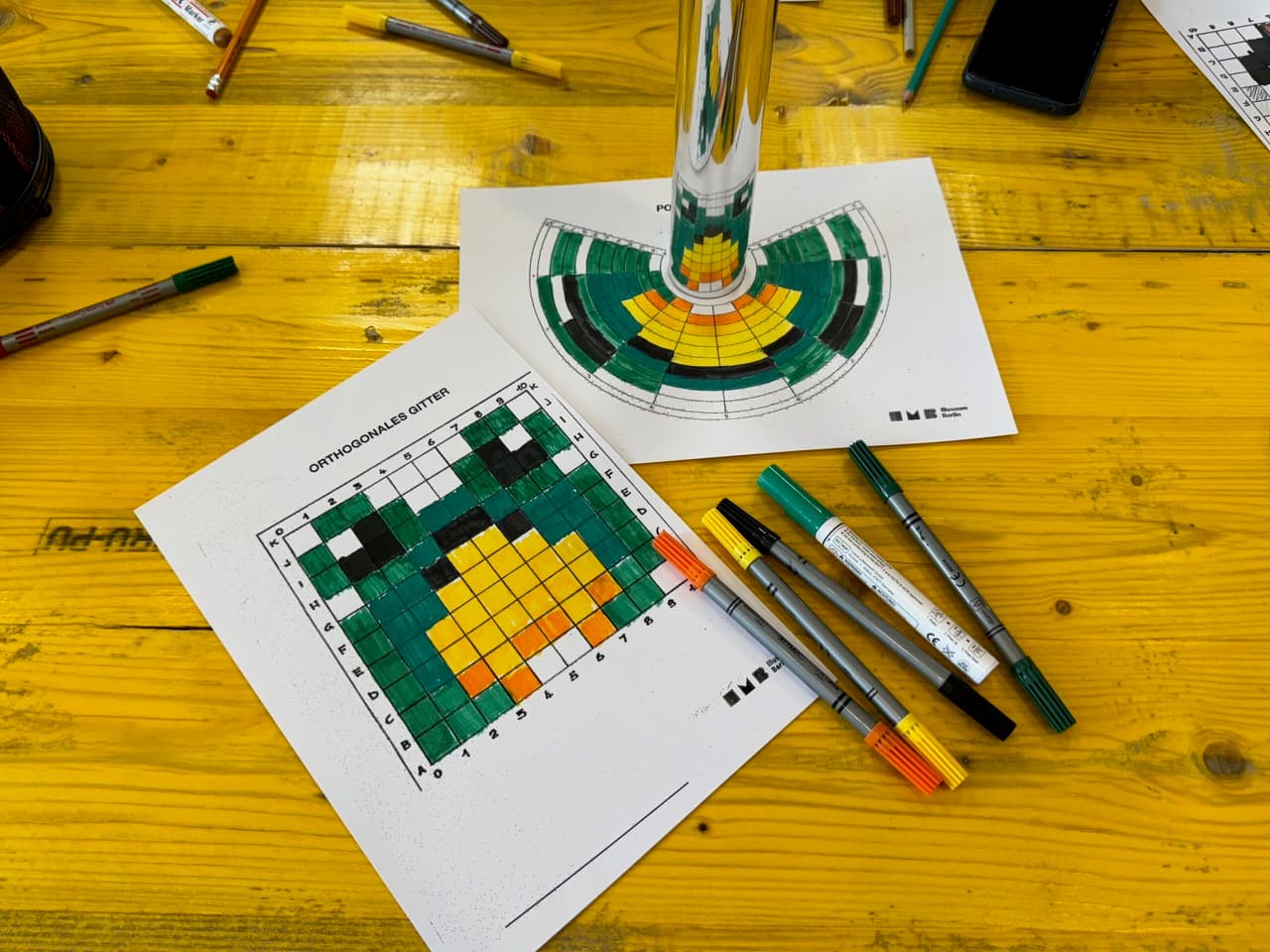
This art form struck us right in the heart like Cupid’s arrow. We’ll tell you why we love it and what makes it so special.
There are several artworks at Illuseum Berlin that have been a permanent part of our exhibition since the very beginning. One of them is an original Reverspective painting by Patrick Hughes – something we are particularly proud of. His works can be found in London in the collections of the British Library, the V&A Museum and Tate – and, drum roll please, right here with us in Berlin!
His works are based on a special form of anamorphosis and, thanks to their playful, fascinating character and surrealist qualities, have become an essential part of both the art world and our museum. Through his three-dimensional works and unique use of optical illusions, Patrick’s art challenges viewers to question their own understanding of perspective and vision. With its depth, his geometric and abstract art often tells a story of its own. So let’s dive into the world and history of anamorphosis.
What Does Anamorphosis Mean and Where Does It Come From?
The word anamorphosis comes from Ancient Greek and means “transformation”. It describes images that can only be recognised correctly from a particular viewing angle or with the help of a special mirror or prism system.
It is an art form that plays with optical illusions and distorted perspectives. The principle is simple: an image or sculpture initially appears distorted or difficult to understand, but from a particular perspective – or with the help of a mirror – a complete and recognisable image emerges. This technique is used in art, architecture, street painting and even advertising to create surprising visual effects.
Anamorphosis is far from a new invention. It has a long history, with its roots in the Renaissance – a period when artists and scientists were already experimenting intensively with perspective and optics. The earliest known anamorphic works date back to the 15th century and are associated with artists such as Leonardo da Vinci and Hans Holbein the Younger.
Leonardo da Vinci’s notebooks contain sketches of distorted drawings that only appear correctly when viewed through mirrors or from particular angles. One famous example is Hans Holbein the Younger’s painting The Ambassadors (1533), which features a distorted skull. Only when viewed from a particular angle – or with the help of a mirror – does the skull become recognisable as a memento mori, a reminder of mortality and the passing of time.
Around 100 years later, Italian painter and architect Andrea Pozzo used anamorphic techniques for illusionistic ceiling paintings in churches. His works were designed with such precise perspective that they create the impression of infinite architectural space and only form a realistic overall image when viewed from a particular position. His most famous work is the ceiling fresco in the Church of Sant’Ignazio in Rome – a must-see for art historians and art lovers!
In the 20th and 21st centuries, the technique continued to evolve in modern art, architecture and advertising. We have already mentioned Patrick Hughes, but anamorphosis has also gained renewed popularity through Street Art artists such as Julian Beever and Felice Varini.
Where and How This Optical Illusion Manipulates Our Perception
Anamorphosis does not only play a role in art – it also influences our everyday lives and our perception. What may seem completely logical to a mathematician can feel like our brain is being completely fooled to everyone else.
Creating an anamorphosis relies on the principles of perspective and geometry. The original image is distorted in such a way that it only returns to its intended form under specific viewing conditions. In digital art, this is often calculated using specialised software. In films and video games, distorted logos or hidden images may only reveal themselves when viewed from the correct perspective.
What initially seems strange or amusing can also serve a very practical purpose. In Street Art, 3D paintings distort our perception because they are designed to work correctly from one particular angle. A good example can be found in road markings or speed-limit signs designed to be easily readable from a driver’s perspective. Through perspective anamorphosis, the image is deliberately distorted so that it appears correct only from a specific viewpoint or position.
With mirror anamorphosis, a distorted image only becomes recognisable when reflected in a cylindrical, conical or prism-shaped mirror.
And when we look up at the night sky, we can find effects related to visual perception there too. One example is the “Moon illusion”: the Moon appears larger near the horizon than when it is high in the sky, even though its actual angular size changes very little. Pretty amazing, right?
We love anamorphosis and we love nature – so it is hardly surprising that we find some fascinating parallels here too.
The term anamorphosis is not limited to art. In zoology, for example, anamorphosis describes a form of development in certain arthropods, including some millipedes, in which additional body segments and legs are added during successive stages of growth.
Many animals also have camouflage patterns or body structures that can create striking visual effects depending on the viewing angle.
Butterflies and other insects use wing patterns that resemble eyes to deter predators. Chameleons and octopuses can alter their colour and, in some species, aspects of their skin appearance to blend into their surroundings. Zebra stripes may also make it more difficult to visually distinguish individual animals when they move together in a group.
Our Conclusion: The Fascinating World of Anamorphosis
Anamorphosis has been with us for centuries and continues to be reinvented. From the mathematical experiments of the Renaissance to modern Street Art, it has constantly evolved and continues to fascinate artists and audiences alike.
Whether in art, science or the wider world of visual perception, anamorphosis demonstrates just how strongly perspective can influence what we see. Once you begin to explore it, you discover a world full of optical illusions and surprising effects.
And that is exactly why we love anamorphosis! Because the heart of Illuseum Berlin beats for creativity, community and environmental protection. For art and nature. And both have an incredible amount to offer one another.